
Skip to content
NEURIXIS

Case studies

What our engineers have shipped.

No logo wall: a client is not a trophy. These are real projects, told without names but with everything that matters, the problem, the approach, the result.

  1. Automating the SORA authorisation file

    The context
    A French drone (UAS) operator, required to follow the SORA 2.5 risk-assessment methodology for its operational authorisation applications. Every flight scenario, with its area, its aircraft and its risk level, opens a new file.
    The problem
    Every application requires a complete file: ConOps, risk assessment, compliance matrix and annexes. That is several days of repetitive drafting per application. These documents constantly cite the flight, maintenance and operations manuals: each time a manual is revised or amended, every cited reference has to be checked one by one, at the risk of letting one slip through.
    The approach
    The automated workflow ingests every available input: GIS data for the area, manuals and supplementary scenario information. A hybrid processing stage first applies the SORA 2.5 methodology deterministically, ground and air risk calculations, SAIL and ARC classes, then a language model drafts the documents, contextualising every element and justification with a systematic citation of its source reference.
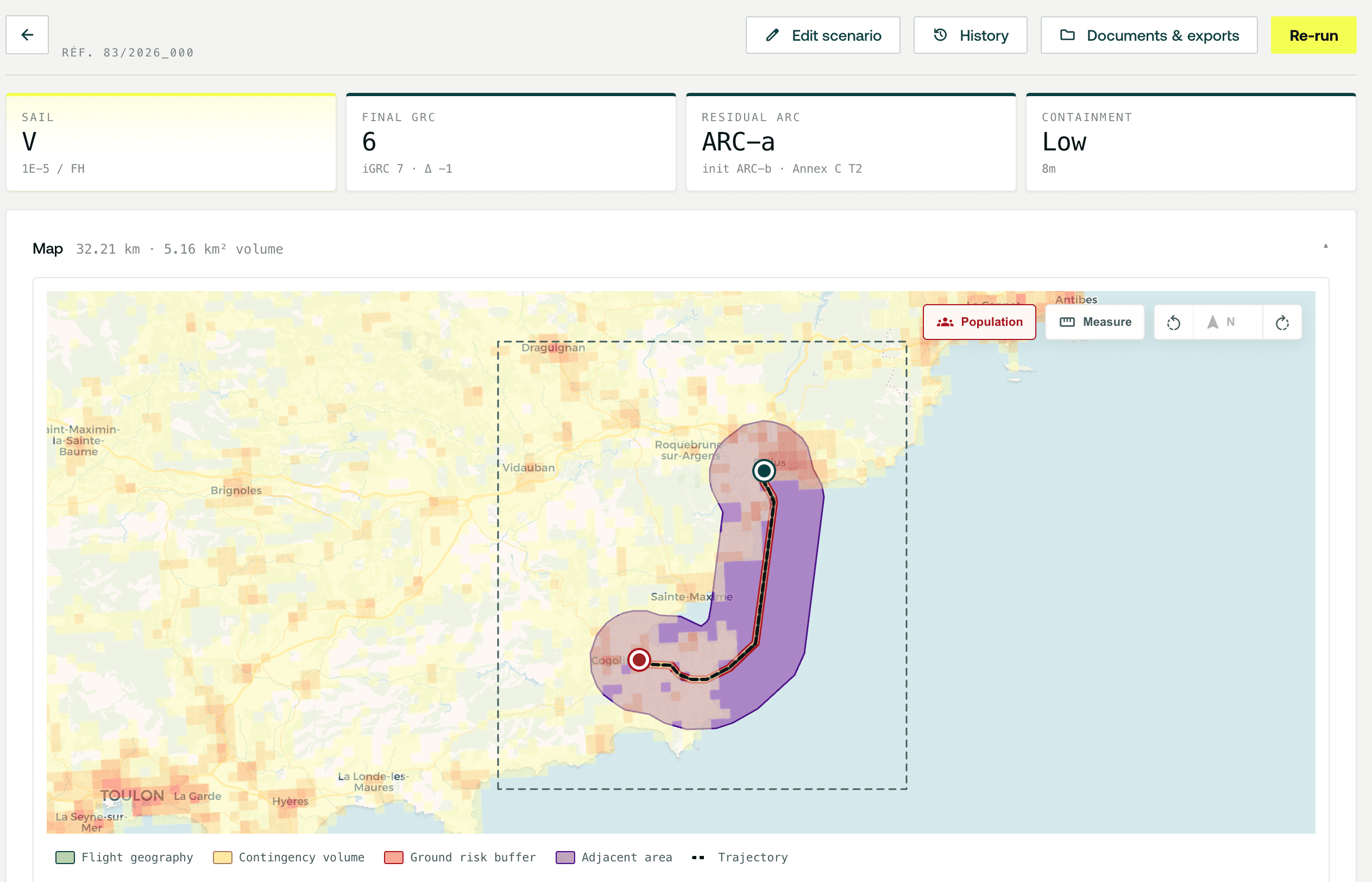
    Screenshot of the SORA tool: SAIL V, final GRC 6, residual ARC-a indicators, and the map of the operation area.
    The workflow in action: SORA parameters computed, operation area drawn, documents ready to export.

    The result

    -75%

    less drafting time

    Drafting drops from several days to a few hours. And cited references keep themselves current: when a manual is amended, the file regenerates instead of being re-read line by line. The risk of error is gone.

  2. Automated generation of immersive property videos

    The context
    A real-estate agency producing immersive videos of its properties from still images. Immersive rendering has become an expectation in listings, but production struggles to keep pace with new mandates.
    The problem
    Every video was assembled by hand in the Runway editor: apply motion codes to the image, iterate until the right movement came out, start again. About three hours per video, with production costs climbing at every iteration. And nothing is capitalised: every image demands its own search, without benefiting from the previous ones.
    The approach
    The model developed is a deep-learning model, trained for regression on a dataset of several thousand images: it predicts the motion parameters to apply to a new image directly, in the format the editor expects, instead of searching for them one by one.

    The result

    -92%

    less production time

    The right movements are predicted in a few minutes instead of three hours, without the iterations that drove the production bill up. Video becomes serial: properties go live at the pace of the mandates, not of the editor.

  3. A real-time voice conversational system

    The context
    A young company building a voice conversational system. Two demands conflict from the start: real-time latency, because a conversation tolerates no silences, and a very high-quality voice, because the voice carries the product.
    The problem
    Available models force a trade-off: fit for real time but robotic-sounding, or a beautiful voice with latency that kills conversation. The classic chain, transcription then reasoning then synthesis, adds up the latency of every brick. None held both constraints at once.
    The approach
    The first iteration chains two custom-built models: a Speech-to-Text, then a Text-to-Speech built on voice-cloning technology, which gives the system its own voice. The second fuses them into a single Speech-to-Speech model: audio in, audio out, with no intermediate text representation. The chain latency disappears, the cloned voice stays.

    The result

    A high-quality voice, tone and prosody included, near-imperceptible latency, and a proprietary model the client owns: no dependency on a third-party API, no per-minute cost.

Let us talk about your use case.

An hour is enough to tell whether your subject stands up. If it does not, we will tell you then, not after three months of project.