
The method
From idea to ROI, in four steps.
We put a number on it before we build, we build what pays, and we set the success criterion from day one. Here is each step in detail: who is in the room, what we produce, how we measure it.
How it runs
The four steps in detail.
Every step produces a concrete deliverable and is judged on an indicator, not on an impression. You decide to move to the next one with the facts in hand.
Step 1 of 4 : AI Quick Wins Workshop
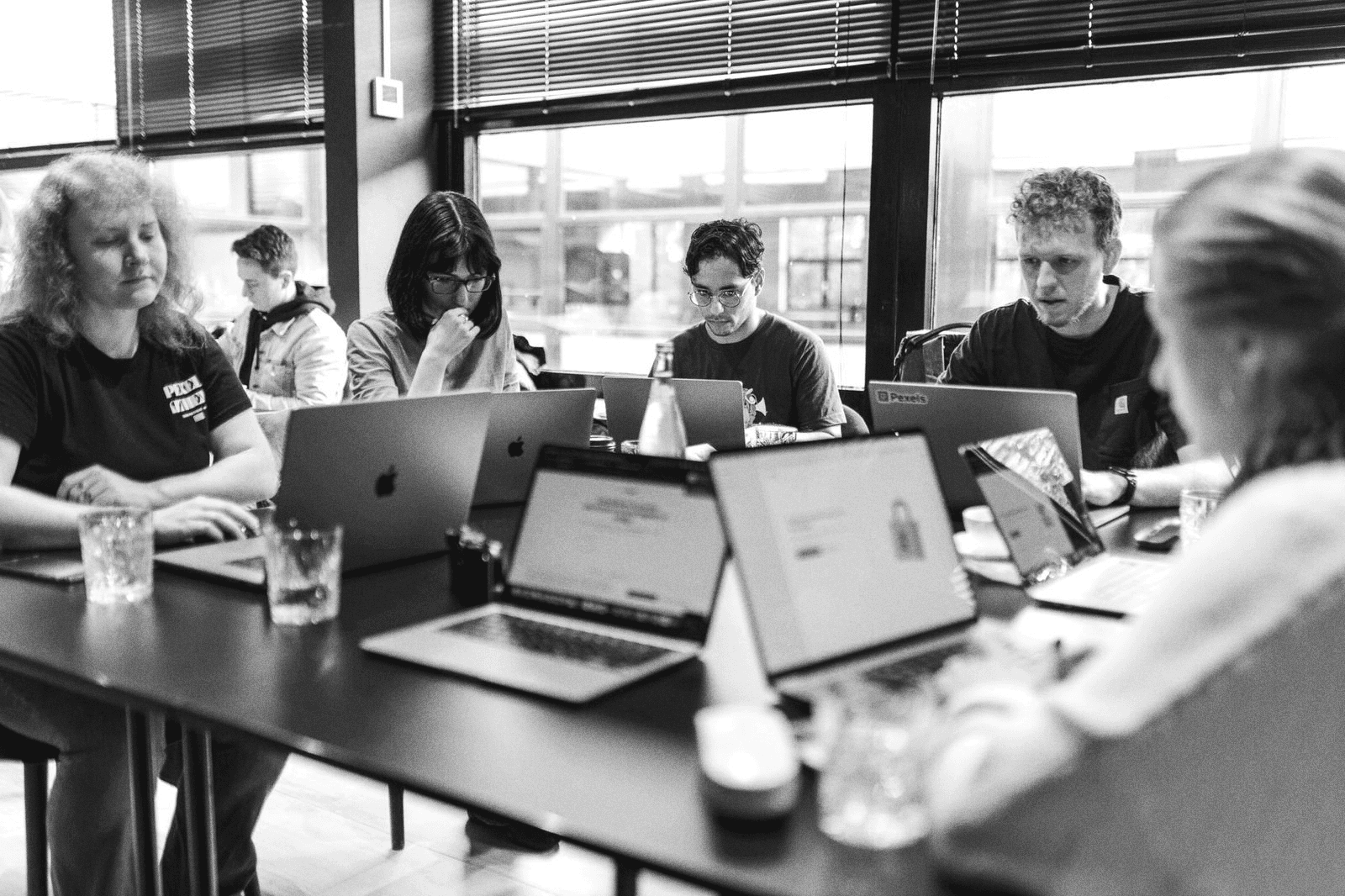
We come to you, we listen to your teams, we map your processes. By the end of the day you leave with your three most profitable use cases, scored and sized in orders of magnitude.
In practice Two of our engineers run the day, facing your business leads and an executive sponsor. We produce a scoping note that ranks each candidate on three axes: feasibility on your data, integration effort, estimated annual gain. The baseline is set that same day, current handling time, error rate, unit cost, the numbers that will settle the decision later.
Deliverable A scoping note with your scored use cases, the order of magnitude of the gain, and the technical path to get there.
Step 2 of 4 : PoC / PoV
We prototype the priority use case on your real data, with a success criterion agreed in the contract from day one: time saved, error rate, unit cost. The PoC either proves the case or kills it. Both outcomes save you money.
In practice A data engineer and a software engineer work on your real data in an isolated environment. We produce a prototype and its evaluation report, measured against the baseline set during scoping. The success criterion is written into the contract before the first line of code: meet it and we industrialise, miss it and we stop, and either way you hold the quantified proof.
Deliverable A prototype running on your data, its quantified evaluation report, and a reasoned decision: industrialise or stop.

Step 3 of 4 : Industrialisation
Go-live inside your information system: secure architecture, MLOps, data governance, AI Act compliance. AI that runs every day, not a demo gathering dust.
In practice Our engineers deploy inside your information system, alongside your teams and within your toolchain. We produce the code, the deployment pipelines, the monitoring and the AI Act compliance file. Go-live is judged on your operating metrics, availability, latency, real inference cost, tracked continuously rather than estimated.
Deliverable The service running in your information system, with its code, its deployment pipelines and its compliance file.

Step 4 of 4 : Run & skills transfer
Monitoring, continuous improvement and training so your teams take ownership of the solution. We are aiming at your autonomy, not your dependency.
In practice One engineer stays on hand while your teams take over. We produce a monitoring dashboard, operating documentation and a training plan built on your own datasets. Autonomy is measured: your engineers handle incidents and retraining on their own, and our presence tapers off until it is gone.
Deliverable A monitoring dashboard, trained teams, and operating documentation your engineers can pick up on their own.
From data to value, with no link left out.
A model is only as good as the chain that feeds it. Most projects stall on data quality and governance, long before the choice of model.
Quality & governance
Completeness and consistency tests, a catalogue, a named owner for each dataset, access traceability. This is where most projects stall, for lack of reliable, documented data.
The workshop
We spend a full day on your site. In the morning we interview your business teams and map the processes that cost you the most: volumes handled, time spent, error rates, manual rework.
In the afternoon we put every candidate through three filters: technical feasibility on your real data, integration effort into your information system, estimated annual gain. Anything that fails one of the three is dropped.
You leave with a summary note: your three most profitable use cases, scored, sized in orders of magnitude, each with the success criterion that would settle the question at the end of a PoC.
If our analysis turns up no use case with a positive ROI within 18 months, we will tell you so in writing. That is what an engineer’s recommendation is worth.
Who qualifies
The workshop is not given. It is earned.
- A sponsor at executive or board level, in the room.
- At least one documented business process shared with us before the day.
- A genuine intention to invest if a profitable use case comes out of it.
You meet the three conditions?
Write to us with the process you would like to improve. We check eligibility and set a date within two business days.
Apply for the workshop